
From Disclosure to Decision: Automating Patent Search Reports for IP Committees
February 2026 - From Patent Search to Decision
How Ambercite powers an automated IP Gate, from disclosure to action
In a previous article, “Reinventing Patent Search with AI”, we explored how professional patent search is evolving beyond traditional keyword-based approaches. By using citation networks, and AI-assisted exploration, Ambercite demonstrated how patent search can surface relevant prior art that conventional methods often miss.
This follow-up article builds on that foundation. It shows how professional patent search can be embedded into a fully automated decision workflow, allowing organizations not only to search better, but to decide earlier, faster, and with greater confidence.
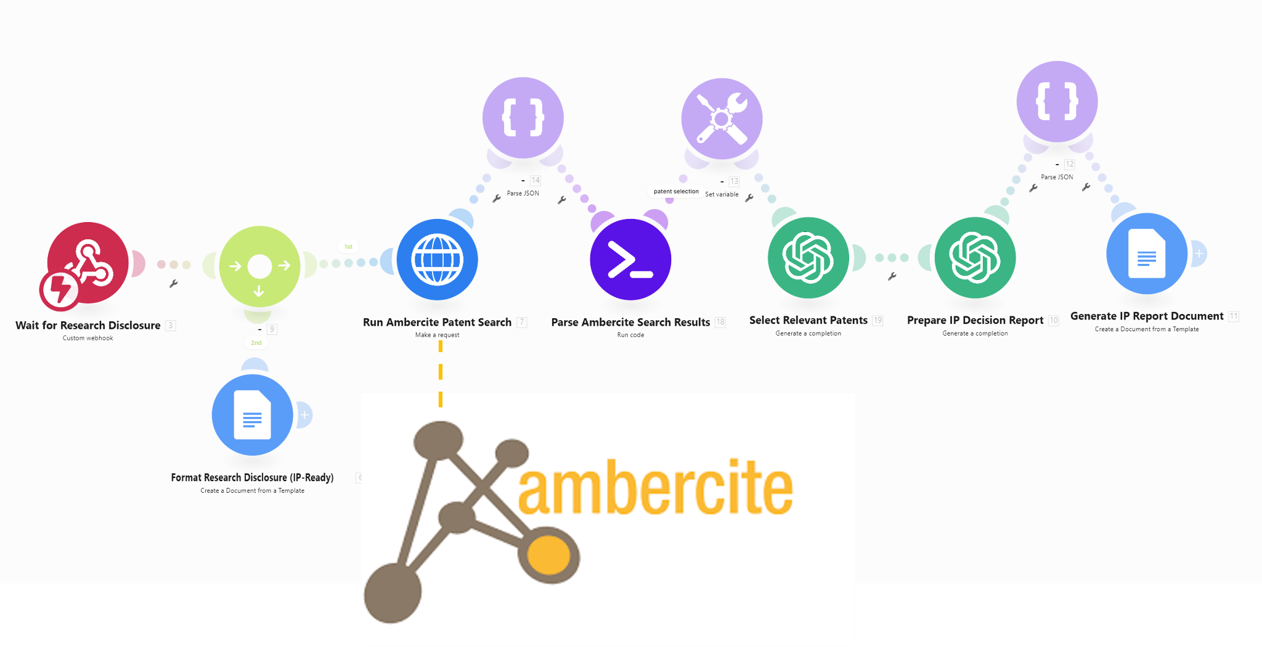
At the center of this workflow is Ambercite, used not as a standalone search tool, but as the authoritative engine supporting internal IP decisions.
What sets Ambercite apart from other search engines? Unlike traditional tools that rely heavily on keyword matching, Ambercite uses a sophisticated computational AI to analyze patent citation networks. It evaluates two types of citations: known citations (directly linked to the seed patent) and unknown citations (indirectly connected patents). Ambercite’s AI calculates the probability that two patents are similar by assessing factors such as citation direction, centrality, structure, and more. This approach helps uncover relevant patents even when they use different terminology.
The challenge is not search quality, but timing and dialogue
Most innovation organizations already recognize the value of patent search. The real difficulty lies upstream. Invention ideas arrive early, informal, and exploratory, while IP teams must reason in terms of novelty, differentiation, and risk. Patent search is often triggered too late, once assumptions have already solidified and internal momentum makes reversal expensive.
The result is a familiar pattern: long lists of patents, difficult interpretation, and slow decisions. What is missing is not more data, but a structured way to connect research intent, professional search, and decision-making.
A concrete example: the foldable umbrella
To illustrate this workflow, we use a simple and familiar example:
This innovation presents a lightweight, foldable umbrella made from durable stainless steel. Featuring a telescopic design, the umbrella is optimized for portability through miniaturization. Its collapsible structure allows for easy opening and closing, offering both convenience and space-saving benefits. Suitable for both rain protection and as a sunshade, this umbrella combines functionality with a sleek design, making it ideal for on-the-go use.For a researcher, this description is meaningful. For an IP decision, it is not yet sufficient. Launching a professional patent search directly from such a description would either miss relevant prior art or return an unmanageable volume of results.
The solution is not to search harder, but to search later and better prepared.
Preparing the disclosure before professional search
Before Ambercite is engaged, the invention idea is clarified and structured into an IP-ready disclosure. The technical problem is made explicit, the inventive concept is clearly articulated, and the elements claimed as differentiating are separated from background features.
To reduce cost and friction at this early stage, a lightweight front-end assistant called GATE-IP™ — Disclosure to Decision is used upstream of the workflow. Researchers submit their ideas through a single interface, where the assistant guides clarification, challenges obvious formulations, and ensures that all information required for a meaningful novelty discussion is present. To avoid hallucination, it identifies one or two potentially relevant patents and asks the researcher to validate them before proceeding. Once complete, the disclosure is submitted directly into the automated workflow. GATE-IP™ does not provide legal advice; it simply ensures that Ambercite is used at the right moment, with the right inputs.
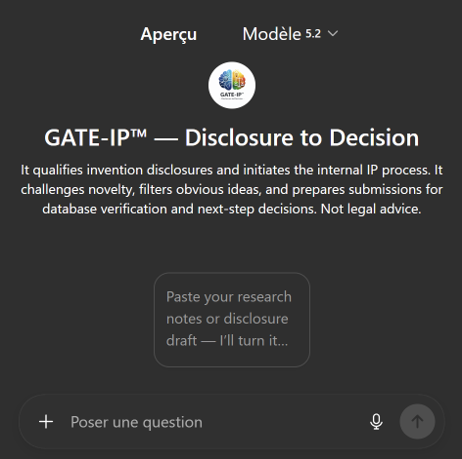
Custom GPT in ChatGPT. The prompt is customized to challenge the researcher and structure the research disclosure, making it ready for an IP lawyer to draft the patent and for the workflow to generate the Patent Search Report (PSR).
Link to the generated research disclosure
At this point, responsibility shifts from the researcher to the IP process.
Format Research Disclosure (IP-Ready)

The workflow starts by generating the IP research disclosure document. It creates a Google Doc that serves as a base, which can then be manually edited by the IP team and the researcher if necessary, before being sent to the IP lawyer for drafting later in the process, after committee validation.
Professional patent search with Ambercite
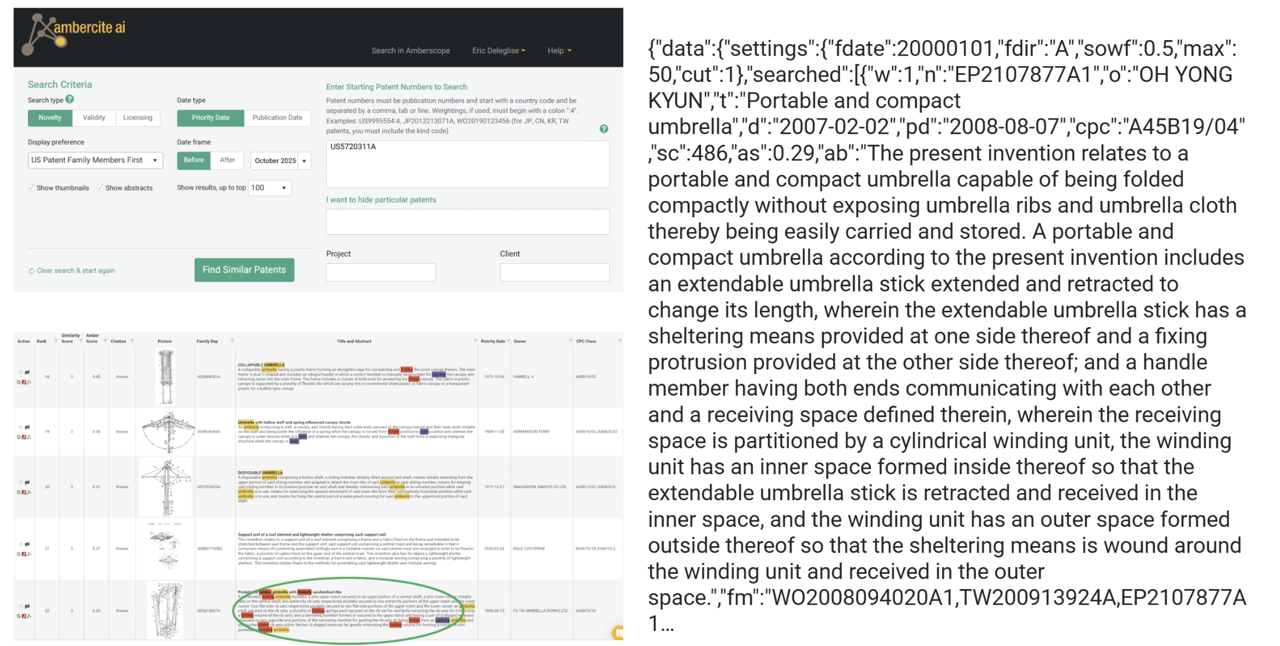
Once the disclosure is structured and anchored, Ambercite becomes the core engine of the workflow. Using its AI-driven similarity analysis and citation networks—described in Reinventing Patent Search with AI—Ambercite expands from the reference patents to uncover related families that traditional keyword or classification searches frequently miss.
Because the search is launched from structured inputs, it is reproducible, traceable, and directly aligned with the invention intent. Ambercite now answers the right question at the right time: what does the patent landscape around this umbrella concept actually look like?
From search results to decision-ready insight

Even high-quality search results are not decisions. Lists of patents must be reduced, compared, and contextualized. An AI interpretation layer is therefore applied after Ambercite search, not to replace expert judgment, but to support it.
The results are filtered to highlight the most relevant patents, compared against the structured umbrella disclosure, and summarized to surface overlap, differentiation signals, and potential obviousness risks. This synthesis is explicitly framed as decision support, not legal assessment.
In this example, we use the 100 most relevant patents and analyze 10 patents in each iteration.
Decision: stop, iterate, or proceed

The workflow concludes with a clear internal decision. In the umbrella example, the outcome may be that the concept is largely covered by existing telescopic designs, that a specific structural variation deserves refinement, or that no meaningful differentiation exists and the idea should stop.
What matters is not the outcome itself, but the process. The decision is made early, deliberately, and with Ambercite’s professional patent intelligence at its core. Legal resources are engaged only when the idea justifies further investment.
The document creates a clear Patent Search Report that can support IP committee decisions.
The generated Google Doc can then be refined by the IP team to improve its quality before it goes to the committee for a decision.
Generated patent search report
Why this matters
This automated IP Gate shows how professional patent search can evolve from a reactive task into a strategic decision capability. By preparing disclosures properly, anchoring ideas in real prior art, and relying on Ambercite as the authoritative search engine, organizations reduce wasted effort and improve alignment between research and IP teams.
The value of Ambercite is not only in the depth of its search, but in its ability to support better decisions earlier in the innovation lifecycle.
Patent search does not create value on its own. Decisions do. Ambercite ensures those decisions are informed by the strongest possible evidence.
How can you install the same process in your organization?
We are already operating this workflow at enterprise scale with a select group of corporate clients.
Early results are highly promising and demonstrate production-grade robustness.
Today, we offer around five ready-to-use template blueprints accessible with our API.
How can I start using Ambercite?
You can try Ambercite yourself in our no-cost trial version, found here:
However, to run these sorts of analyses discussed in our blog, you will need to contact us about a corporate subscription. If you do contact us, we would be very happy to provide an online demonstration of the above approach on one of your subject.