
What Is an AI Prior Art Search Agent? Why Ambercite Was Built for This Moment
April 2026 — Everyone is talking about AI agents: systems that can search, reason, improve outputs, run workflows, and produce reports. It sounds new. But in patent search, an important part of that logic already existed years ago. Ambercite built a model based on iterative search long before “agentic AI” became a trend, and that approach may now be more relevant than ever.
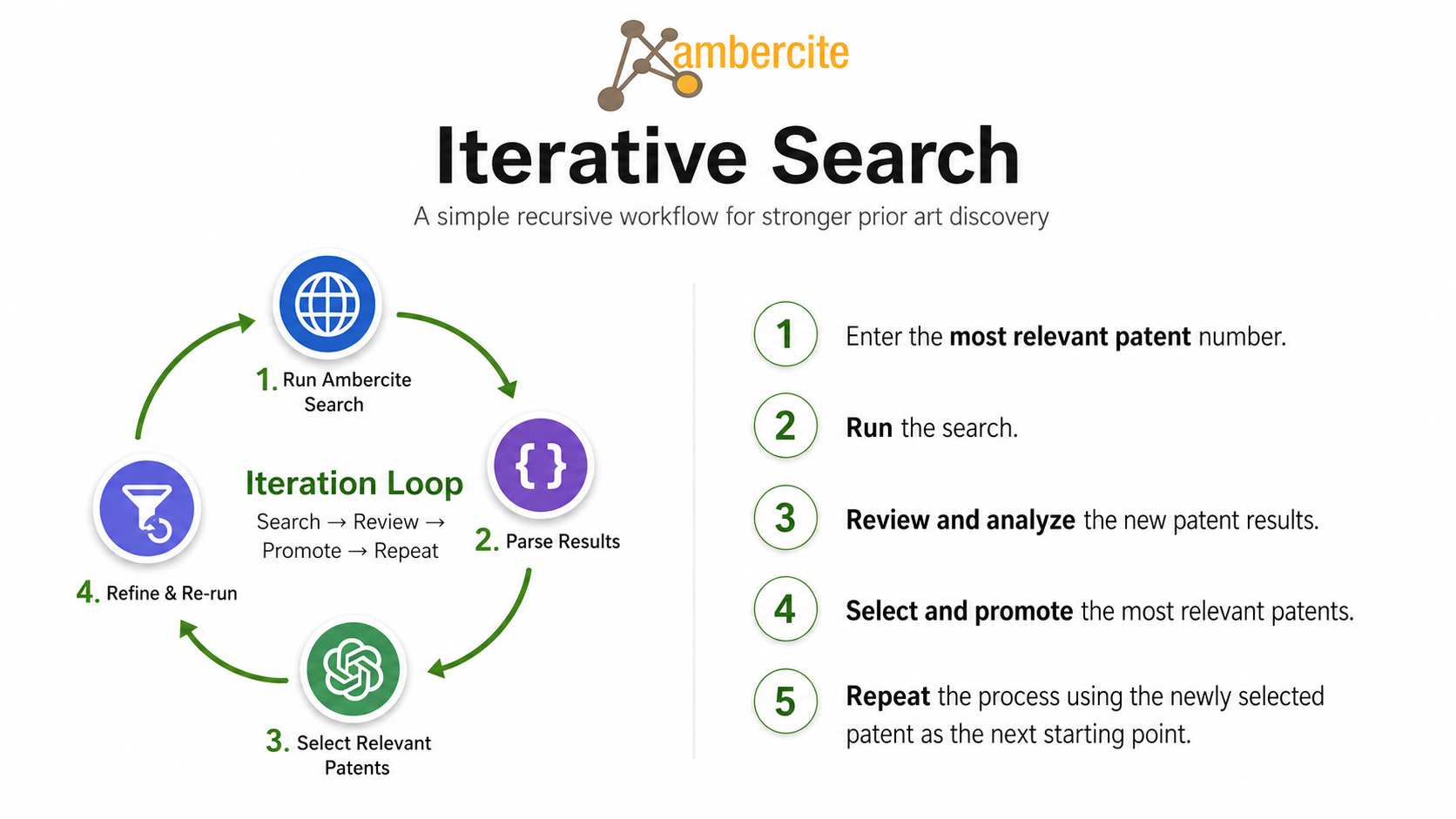
Before AI Hype, There Was Iterative Intelligence
Patent search is often presented today as if it were a simple conversational task. In practice, it is much closer to an iterative research process, where the quality of the result improves through multiple cycles rather than a single prompt.
Many current tools try to solve patent search like a chatbot:
Ask one question. Get one answer.
But experienced professionals know that real patent search rarely works in one pass.
The best results usually come from iteration:
start with a relevant patent
review connected results
identify stronger references
rerun the search
remove duplicates
repeat until confidence is high
That was already a core part of Ambercite’s workflow.
Original reference:
https://www.ambercite.com/amberblog/2019/3/19/use-iterative-searching-nayrh
This is not just search.
It is recursive improvement.
And that is one of the foundations of modern agent systems.

Run the search
Enter the most relevant patent number and run the search.

Review
Review and analyze the results.
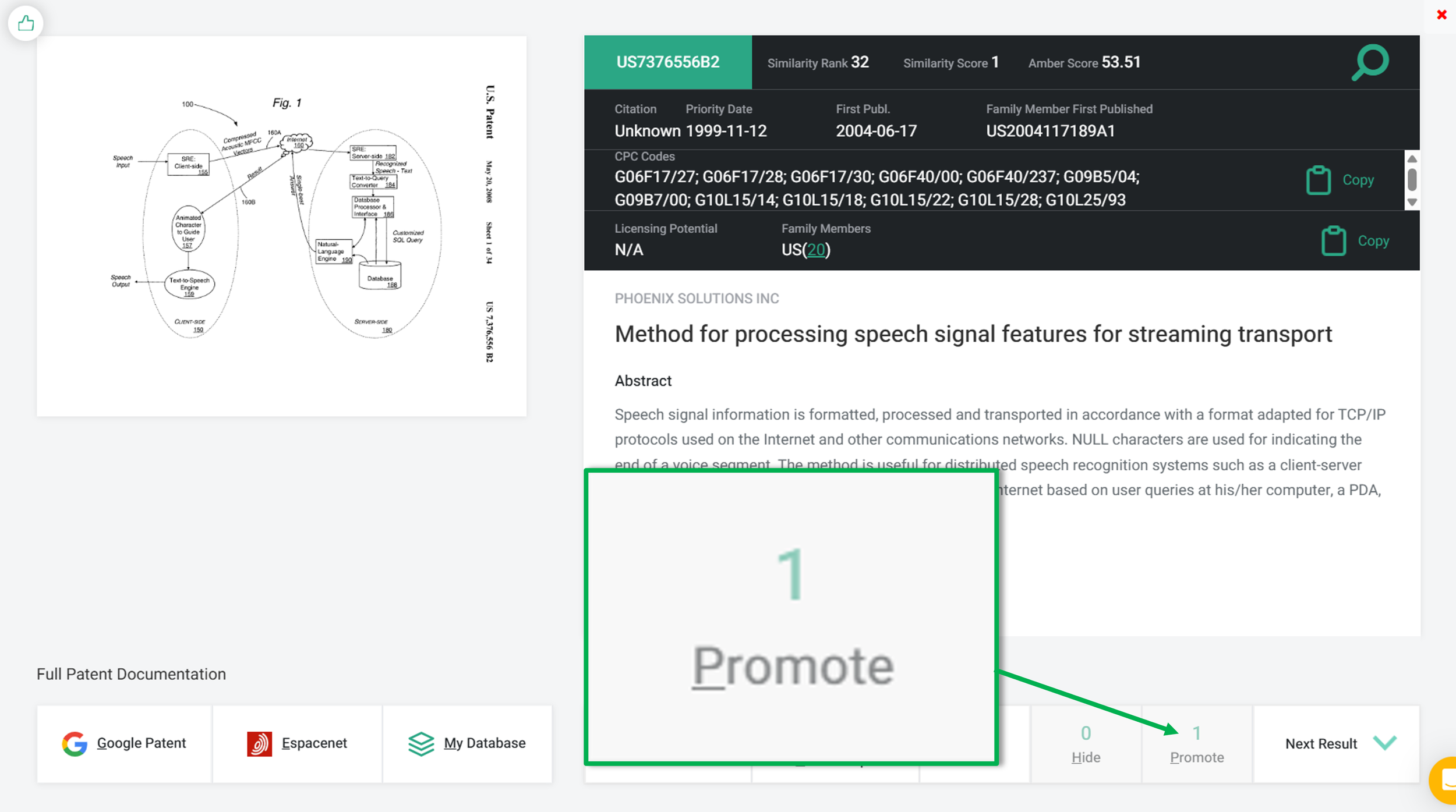
Promote
Promote relevant patents and rerun the search.
Why This Matters Now
A large language model can absolutely assist patent work. It can summarize claims, compare inventions, explain prior art, draft reports, and propose strategies.
But asking an LLM to perform the entire discovery process can become expensive very quickly.
Serious prior art search may require hundreds of documents, multiple search loops, ranking passes, keyword expansions, and literature checks. If the LLM is asked to handle all of that directly, token usage increases fast — and so does the cost of the workflow.
That is why the better architecture is often not “LLM does everything.”
It is:
Use a strong search engine for discovery. Use AI for reasoning. Use humans for final judgment.
What humans were previously doing manually through the Ambercite interface — selecting seed patents, running iterative searches, reviewing new results, promoting relevant patents, and repeating the process — can now be executed by an AI agent through the Ambercite API.
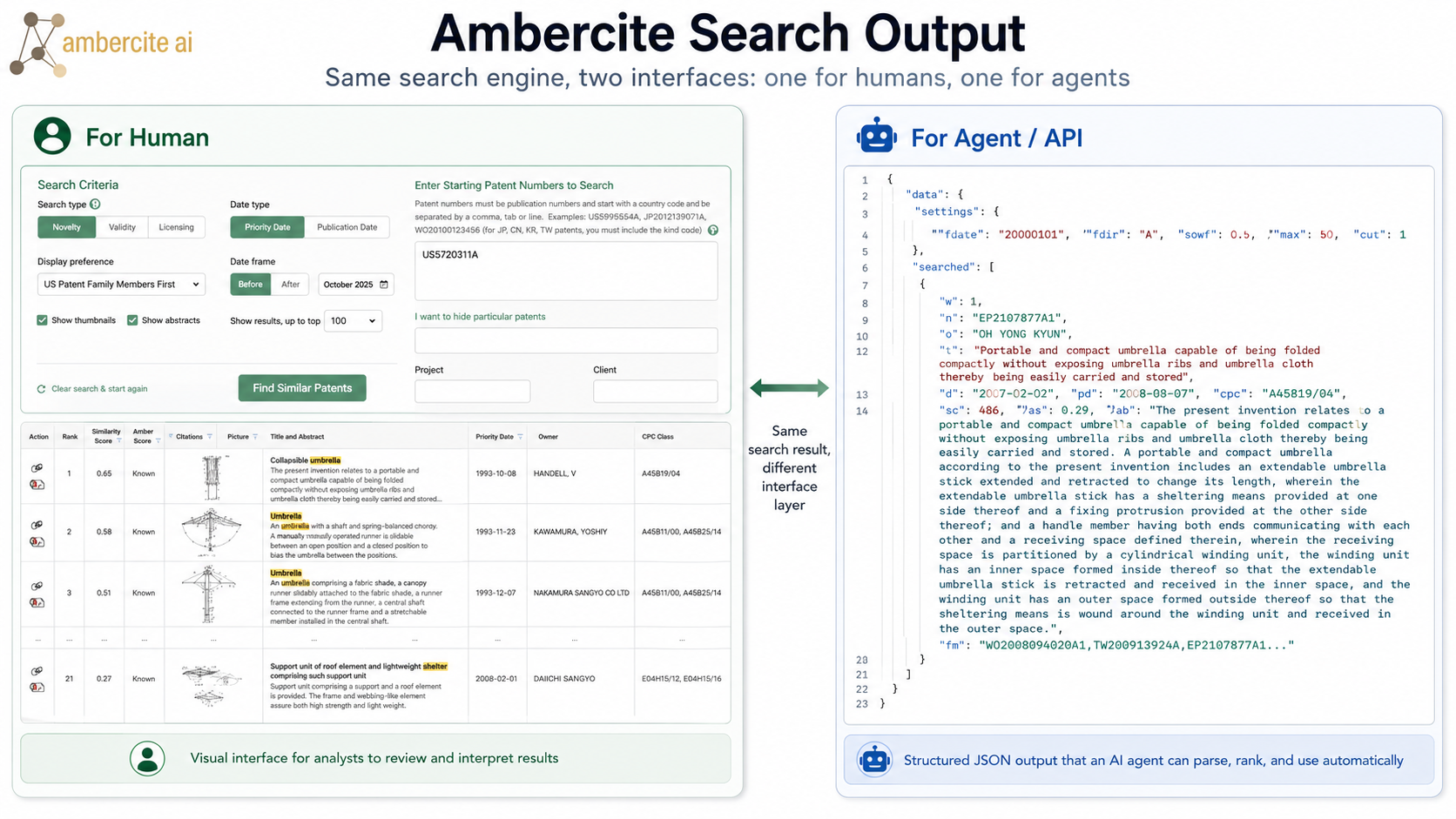
Agents being built on top of the Ambercite AI API.
A common criticism is that Ambercite is “not complete.” But no single patent search method delivers perfect recall. Ambercite was designed to work alongside other methods, not to replace them.
Its core strength is citation-network intelligence: identifying relevant patents through the way inventions are connected. This is especially powerful when citation data is rich, but some patents may still be harder to detect when citation links are weak or incomplete.
That is why the strongest workflow is hybrid. Traditional keyword search can help expand coverage, but it is often imprecise: it may retrieve many noisy results, forcing the AI to spend a lot of tokens filtering irrelevant documents. Ambercite helps reduce that noise by starting from citation relationships, while AI-based keyword expansion and a short non-patent literature layer can be added before or after the iterative search to capture additional references from patents, papers, standards, product documentation, and other public disclosures.
This is no longer just one search or one chatbot answer. What you need is a recursive patent search and analysis system.
MCP as new standard to be consumed by Claude and other agentic system
With MCP becoming a new standard for connecting tools directly to agentic systems such as Claude and others, the Ambercite API can be consumed not only through our own interface, but also as a native “patent search capability” inside external AI workflows. This means an agent can call Ambercite directly when it needs citation-network intelligence, retrieve structured search results, compare them with keyword or web-based findings, and decide the next step autonomously. In this model, Ambercite becomes the specialized patent-search engine inside a broader AI agent: the agent reasons, plans, and reviews, while Ambercite provides the reliable patent-discovery layer through its API.
Our service can now be integrated into Claude with very little effort. Contact us if you are interested in trying it out.
Why Cost Matters
With this architecture, a highly comprehensive patent search strategy can be run efficiently, without forcing the entire discovery process into an expensive LLM-only pipeline.
Instead of asking the AI to search, read, filter, and reason through large volumes of noisy results, Ambercite provides a structured patent-discovery layer first. The AI can then focus its tokens where they create the most value: completing the search, reviewing gaps, analyzing relevance, and improving the next iteration.
Chat Is Useful — But Chat Is Not the Product
Many companies confuse the interface with the system. Chat is just one way to interact.
The same workflow can be triggered through:
chatbot
email
API
CRM workflow
internal portal
The value is not the chat box, the value is the engine behind it.
Ready to test your own agent?
You can start today. We will provide you with the instructions to integrate Ambercite AI directly into Claude or other agentic platforms.
The system is flexible. Then, the best starting input is whatever you already have: an invention description, a few relevant patent numbers, or specific search instructions.
Final Thought
Sometimes innovation is not replacing the old model.
It is recognizing that an older model was already right — and adding the missing layer.
Ambercite built the foundation.
Now the agent layer is catching up.
#AI #Patents #IP #LegalTech #Innovation #Search #AgenticAI